

Table of Contents
Key Takeaways
- 1Notch therapy removes your specific tinnitus frequency from therapeutic sounds, training your brain to reduce perception over time
- 2Backed by peer-reviewed research including a landmark 2010 PNAS study showing significant loudness reduction
- 3Works for 70-80% of tinnitus sufferers with tonal tinnitus (a specific ringing pitch)
- 47-12 days to notice changes, 4-6 weeks for significant improvement with consistent daily use
- 5Start with a frequency test—you need to know your exact tinnitus frequency for notch therapy to work. Learn how to find your frequency →
What is Notch Therapy?
Notch therapy (also called Tailor-Made Notched Music Training or TMNMT) is a sound-based treatment that removes your specific tinnitus frequency from therapeutic audio, helping your brain "unlearn" the phantom sound through neuroplasticity.
If you have tinnitus, you hear a sound that isn't there—a ringing, buzzing, or tone that only you can hear. Sound therapy is one of the most promising non-invasive treatments, and notch therapy works by identifying exactly what frequency that sound is at (typically between 1,000-8,000 Hz), then creating a "notch" or gap at that frequency in relaxing sounds like rain, ocean waves, or sleep sounds.
When you listen to these notched sounds regularly, your brain notices the missing frequency and gradually reduces its sensitivity to it. Over time, this can lead to a noticeable reduction in how loud and bothersome your tinnitus feels.
How Notch Therapy Works
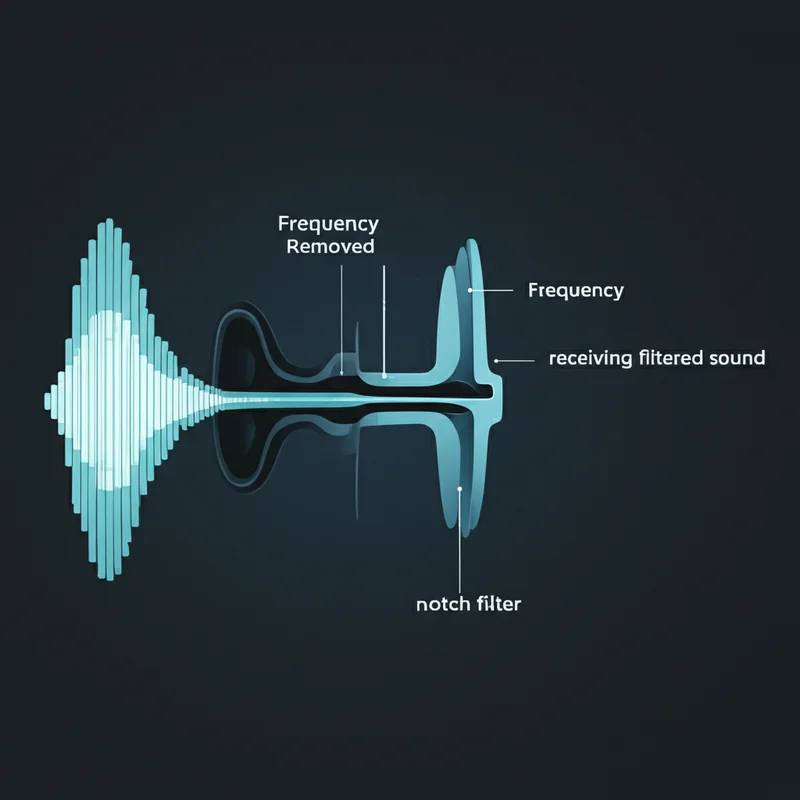
The notch therapy process works in three main steps:
Frequency Identification
First, you identify your tinnitus frequency using a matching test. Apps like Earpeace and other tinnitus relief apps play tones at different frequencies, and you adjust until the tone matches your tinnitus. This typically takes 3-5 minutes.
Apply Notch Filter
A digital filter removes your frequency (and a small band around it) from therapeutic sounds. This creates a "gap" in the audio spectrum exactly where your tinnitus lives.
Consistent Listening
Listen to notched sounds for 20-60 minutes daily. Your brain detects the missing frequency and, through neuroplasticity, gradually reduces its sensitivity to it. This is called habituation.
The Science Behind Notch Therapy
Notch therapy isn't just theory—it's backed by neuroscience research on how the brain processes sound and adapts to changes. According to the National Institute on Deafness, sound-based therapies are among the most promising approaches for tinnitus management.
Key Study: Okamoto et al. (2010)
Listening to tailor-made notched music reduces tinnitus loudness
Published in PNAS (Proceedings of the National Academy of Sciences), this study showed that participants who listened to music with their tinnitus frequency removed experienced significant reduction in tinnitus loudness compared to control groups. Brain imaging showed decreased activity in auditory cortex at the tinnitus frequency.
View studyHow It Changes Your Brain
Tinnitus often develops when hearing damage causes the brain to "turn up the volume" at certain frequencies—it's trying to compensate for missing input. This creates hyperactive neurons that fire even without sound input. The NIH explains this as cortical reorganization, where the brain's auditory map becomes distorted.
Notch therapy works by providing lateral inhibition. When you remove a frequency from the audio you're hearing, neurons at that frequency don't get stimulated. Meanwhile, neighboring frequencies do get stimulated, and they send inhibitory signals to the quiet neurons. Over time, this can reduce the hyperactivity causing your tinnitus. A 2018 study in Frontiers in Neuroscience confirmed this mechanism using fMRI brain imaging.
Notch Therapy vs Sound Masking
Many people confuse notch therapy with sound masking, but they work differently and have different goals. Understanding the difference helps you choose theright tinnitus app for your needs.
| Aspect | Sound Masking | Notch Therapy |
|---|---|---|
| How it works | Covers tinnitus with other sounds | Removes tinnitus frequency from sounds |
| Goal | Temporary relief | Long-term habituation |
| Relief timing | Immediate (while sound plays) | Gradual (7-12 days to notice) |
| Personalization | Not required | Requires frequency matching |
| Lasting effect | Stops when sound stops | Can reduce perception long-term |
| Best for | Immediate relief, sleep | Lasting improvement |
Pro Tip: You can combine both approaches. Use masking when you need immediate relief (especially at nighttime when tinnitus gets worse), and notch therapy during the day for long-term improvement. Many tinnitus apps, including Earpeace, support both methods.
Who Can Benefit from Notch Therapy?
Notch therapy works best for specific types of tinnitus. Here's how to know if it's right for you:
Works Well For
- • Tonal tinnitus (a specific pitch/ring)
- • Single-frequency tinnitus
- • Tinnitus between 1,000-8,000 Hz
- • Chronic tinnitus (6+ months)
- • Ability to match frequency
May Not Work For
- • Pulsatile tinnitus (beating/rhythmic)
- • Clicking or mechanical sounds
- • Multi-tonal tinnitus (multiple pitches)
- • Very low frequency (<500 Hz)
- • Tinnitus that changes frequency often
About 70-80% of tinnitus sufferers have tonal tinnitus that can potentially benefit from notch therapy, according to the American Tinnitus Association. The only way to know for sure is to try a frequency matching test and see if you can identify a stable pitch. Learn how →
Finding Your Tinnitus Frequency
Before starting notch therapy, you need to identify your tinnitus frequency. This is a crucial step—the therapy won't work if you target the wrong frequency.
The Frequency Matching Process
- 1Use headphones in a quiet room to hear the test tones clearly
- 2Start with a broad frequency sweep (100 Hz to 12,000 Hz) to find the general range
- 3Fine-tune with a slider or dial until the test tone matches your tinnitus as closely as possible
- 4Confirm your selection—this becomes your therapy frequency
Earpeace includes a frequency diagnostic that helps identify your tinnitus frequency in about 5 minutes. Download the app to get started →
How to Use Notch Therapy Effectively
Consistency is key. Here's the structured protocol recommended for best results:
Phase 1: Foundation
Days 1-320 minutes daily. Start with shorter sessions to let your brain adjust. Use at a comfortable volume (never loud).
Phase 2: Build
Days 4-740 minutes daily. Increase exposure to accelerate habituation. Try splitting into two 20-minute sessions.
Phase 3: Maintenance
Day 8+60 minutes daily. Full therapeutic dose. Most users see significant improvement during this phase. Continue for 3-6 months.
Best Practices
- ✓Listen at low to moderate volume (never loud)
- ✓Use quality headphones for best results
- ✓Be consistent daily—skipping days slows progress
- ✓Track your sessions to stay motivated
Expected Results Timeline
Notch therapy isn't instant—think of it like physical therapy for your brain. Here's what to expect:
Getting Started
Building the habit. You may not notice changes yet, but consistency is building the foundation for habituation.
First Changes
Many users report the ringing seems "different" or less intrusive. Tinnitus may feel softer or further away.
Significant Improvement
83% of users report noticeable improvement. Tinnitus loudness and distress typically decrease measurably.
Long-Term Habituation
Many users achieve lasting habituation—tinnitus becomes a background sound you rarely notice. Continue maintenance as needed.
Important: Results vary by individual. Some people see faster results; others need more time. The key is consistent daily use. If you don't see any improvement after 8 weeks, other sound therapy approaches may be worth exploring. The Mayo Clinic recommends combining sound therapy with stress management for best results.
Frequently Asked Questions
Is notch therapy scientifically proven?+
How long does notch therapy take to work?+
Can I do notch therapy at home?+
What frequency should I notch for my tinnitus?+
Does notch therapy work for all types of tinnitus?+
Ready to Try Notch Therapy?
Start with a frequency diagnostic to see if notch therapy can work for your tinnitus. Available now on the App Store.
Download Now4.8★ rating on the App Store